
February 8th, 2021 – Limerick, Ireland.
Ashling announced immediate availability of an integrated Code Coverage Tool for Arm and RISC-V based target applications within Ashling’s RiscFree™ IDE and Debug solution.
Identifying untested code is an essential part of any software test plan, and an automated means of recording the coverage of source code during unit test execution is either required or recommended by many software engineering standards. Measuring code coverage—the percentage of the overall software system that has been executed at least once—provides a quantitative measure of confidence in the design. It also helps answer a key software engineering question: when can we stop testing?
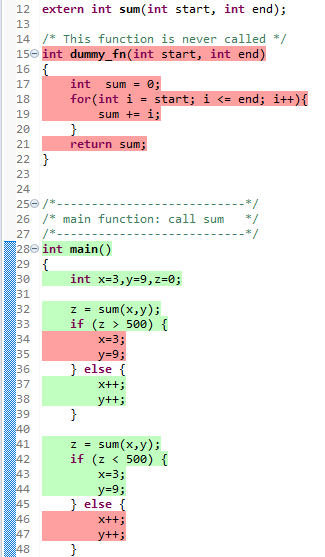
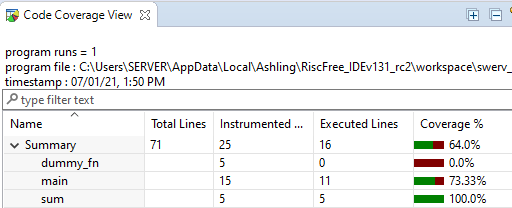
RiscFree™ records and displays the code memory addresses which are accessed during testing, enabling developers to determine which sections of code have been executed and which have not. Coverage information is presented in the Source and Code Coverage Views of the IDE.
RiscFree™ IDE, Ashling’s professional, commercial-grade software development environment, includes support for embedded 32-bit and 64-bit Arm and RISC-V devices. The Eclipse-based IDE provides a seamless environment for development—from writing and building code to simulating and hardware debugging. RiscFree™ IDE has heterogeneous multicore debug capabilities and can be used with Ashling’s Opella-XD hardware debug probe and OpenOCD-compatible probes.
Ashling Microsystems is an international Embedded Software Solutions and Debug Tools company, providing high-performance software and hardware tools for a range of embedded 32-bit and 64-bit architectures. Through close cooperation with leading semiconductor vendors, Ashling is a global leader in the Embedded Software Development Tools market. Ashling’s development centre is in Limerick, Ireland, with sales and support representatives worldwide. Visit www.ashling.com for more details.
Róisín O’Keeffe, VP Global Business Development
Email: roisin.okeeffe@ashling.com
All trademarks, logos, and brand names are the property of their respective owners.